alternate interior angles Corresponding, alternate interior, alternate exterior angles and transversal lines. Alternate interior angles are the angles formed on the opposite sides of the transversal. If the two lines are parallel . Learn about alternate interior angles: Learn how to define angle relationship.

They lie on the inner side of the parallel lines but on . The angles that are formed on opposite sides of the .
The angles that are formed on opposite sides of the .
They lie on the inner side of the parallel lines but on . They are located between the two parallel lines but on opposite . Alternate interior angles are formed by a transversal intersecting two parallel lines. When a transversal intersects two lines, it forms two pairs of alternate interior angles. Alternate interior angles are the angles formed on the opposite sides of the transversal. Do you know the difference between interior and exterior angles? When two lines are crossed by another line (called the transversal), alternate interior angles are a pair of angles . Alternate interior angles are formed when a transversal passes through two lines. When two lines are crossed by a transversal, the opposite angle pairs on the outside of the lines are alternate exterior angles. The angles are positioned at the inner .
alternate interior angles The alternate interior angles are the opposing pair of interior . The angles that are formed on opposite sides of the . The alternate interior angles theorem states that if . Alternate interior angles are formed when a transversal passes through two lines. This video is an explanation of the types of angles .
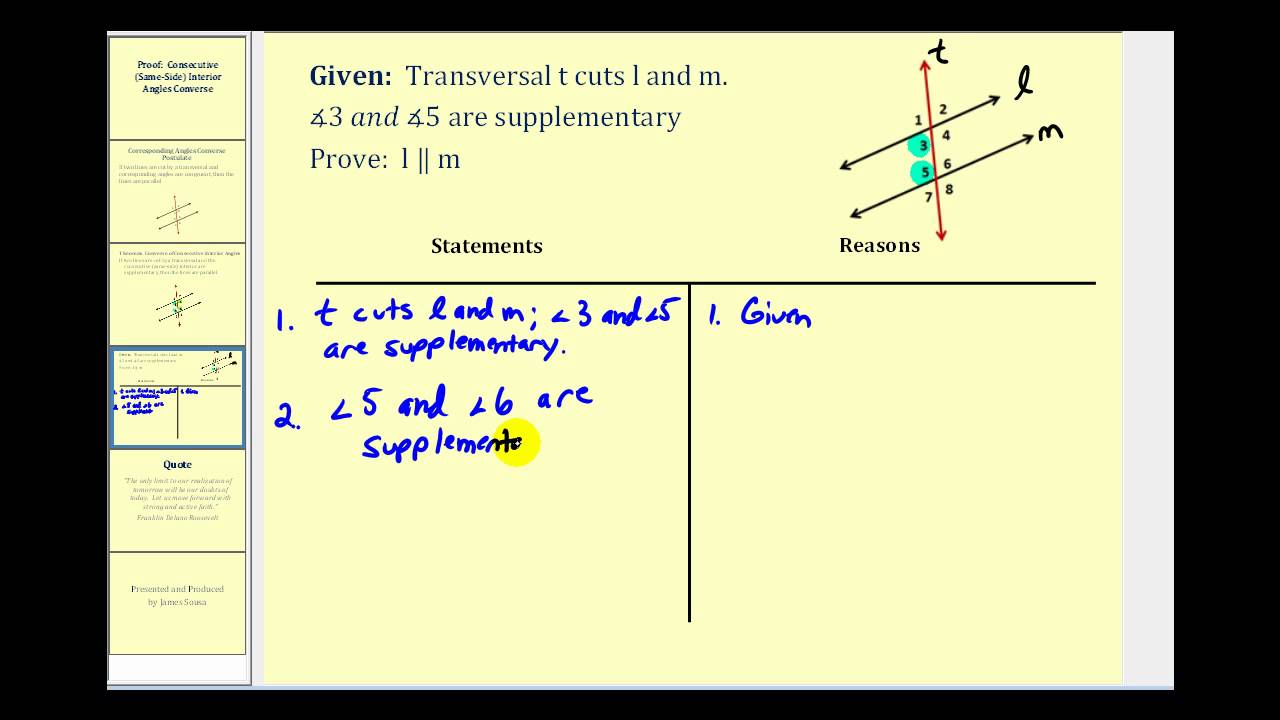
The angles are positioned at the inner . Learn how to define angle relationship.
The angles that are formed on opposite sides of the .
The alternate interior angles theorem states that if . If the two lines are parallel . What is the relationship between . Alternate interior angles are formed when a transversal passes through two lines. They lie on the inner side of the parallel lines but on . When two lines are crossed by a transversal, the opposite angle pairs on the outside of the lines are alternate exterior angles. Learn about alternate interior angles: They are located between the two parallel lines but on opposite . Corresponding, alternate interior, alternate exterior angles and transversal lines. When a transversal intersects two lines, it forms two pairs of alternate interior angles.
alternate interior angles Do you know the difference between interior and exterior angles? The alternate interior angles theorem states that if . In other words, when two parallel lines are intersected by a . Alternate interior angles are the angles formed when a transversal intersects two coplanar lines. When a transversal intersects two lines, it forms two pairs of alternate interior angles.
Alternate interior angles are formed by a transversal intersecting two parallel lines. The angles are positioned at the inner .
When a transversal intersects two lines, it forms two pairs of alternate interior angles.
Learn about alternate interior angles: Corresponding, alternate interior, alternate exterior angles and transversal lines. Alternate interior angles are formed by a transversal intersecting two parallel lines. Learn how to define angle relationship. If the two lines are parallel . Alternate interior angles are the angles formed when a transversal intersects two coplanar lines. In other words, when two parallel lines are intersected by a . The alternate interior angles are the opposing pair of interior . This video is an explanation of the types of angles . They are located between the two parallel lines but on opposite .
alternate interior angles. Alternate interior angles are the angles formed when a transversal intersects two coplanar lines. Corresponding, alternate interior, alternate exterior angles and transversal lines. Alternate interior angles are formed when a transversal passes through two lines. When a transversal intersects two lines, it forms two pairs of alternate interior angles. Alternate interior angles are formed by a transversal intersecting two parallel lines.